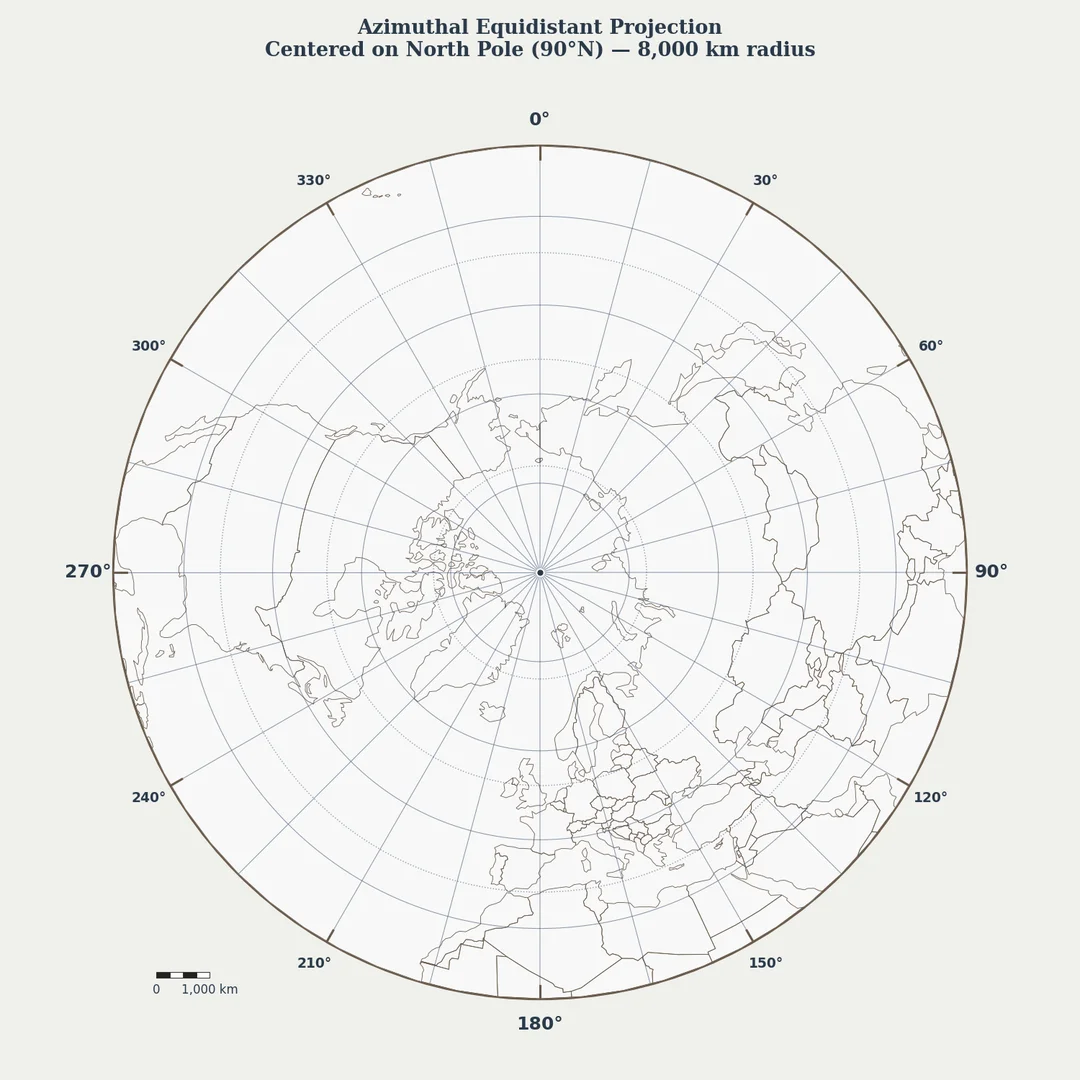
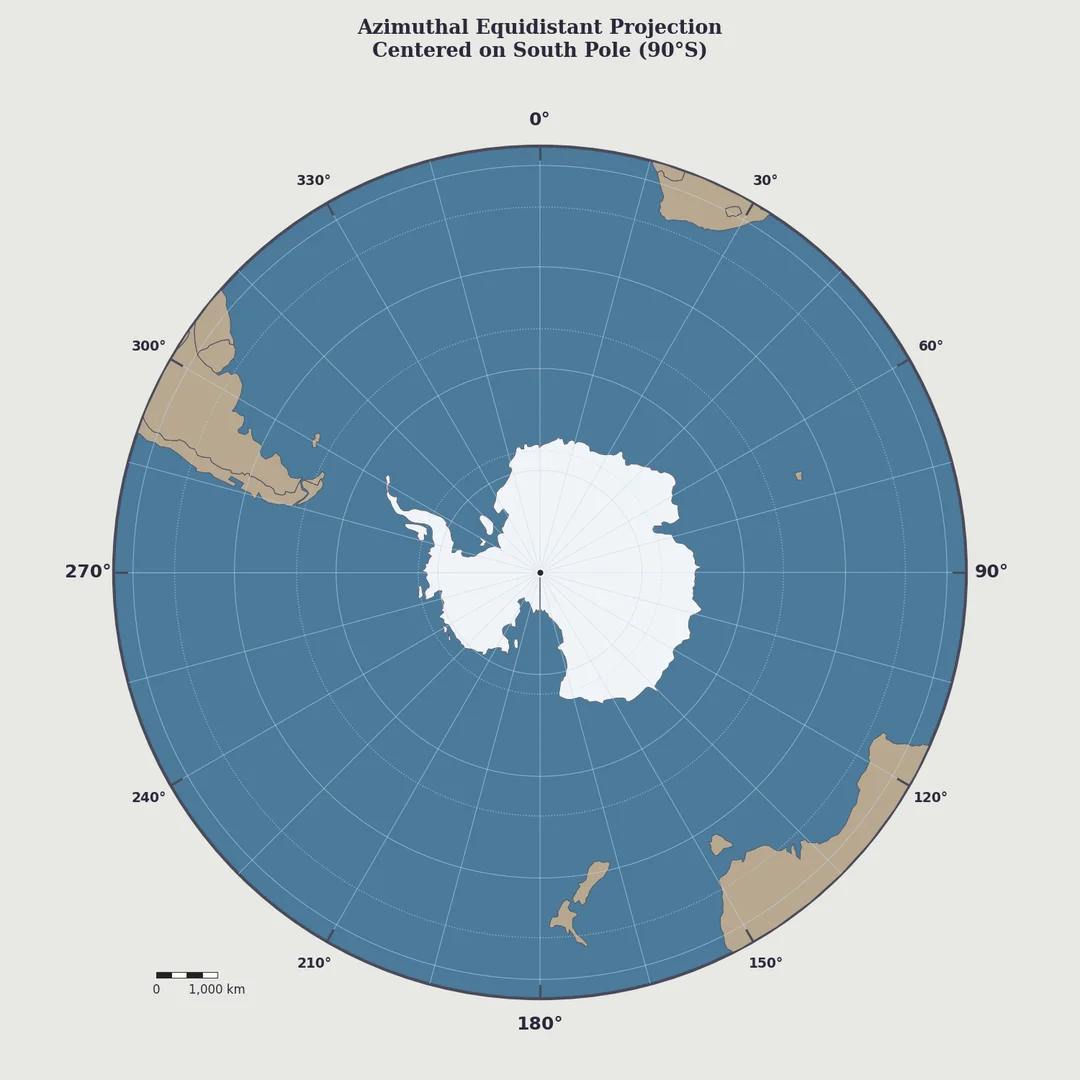
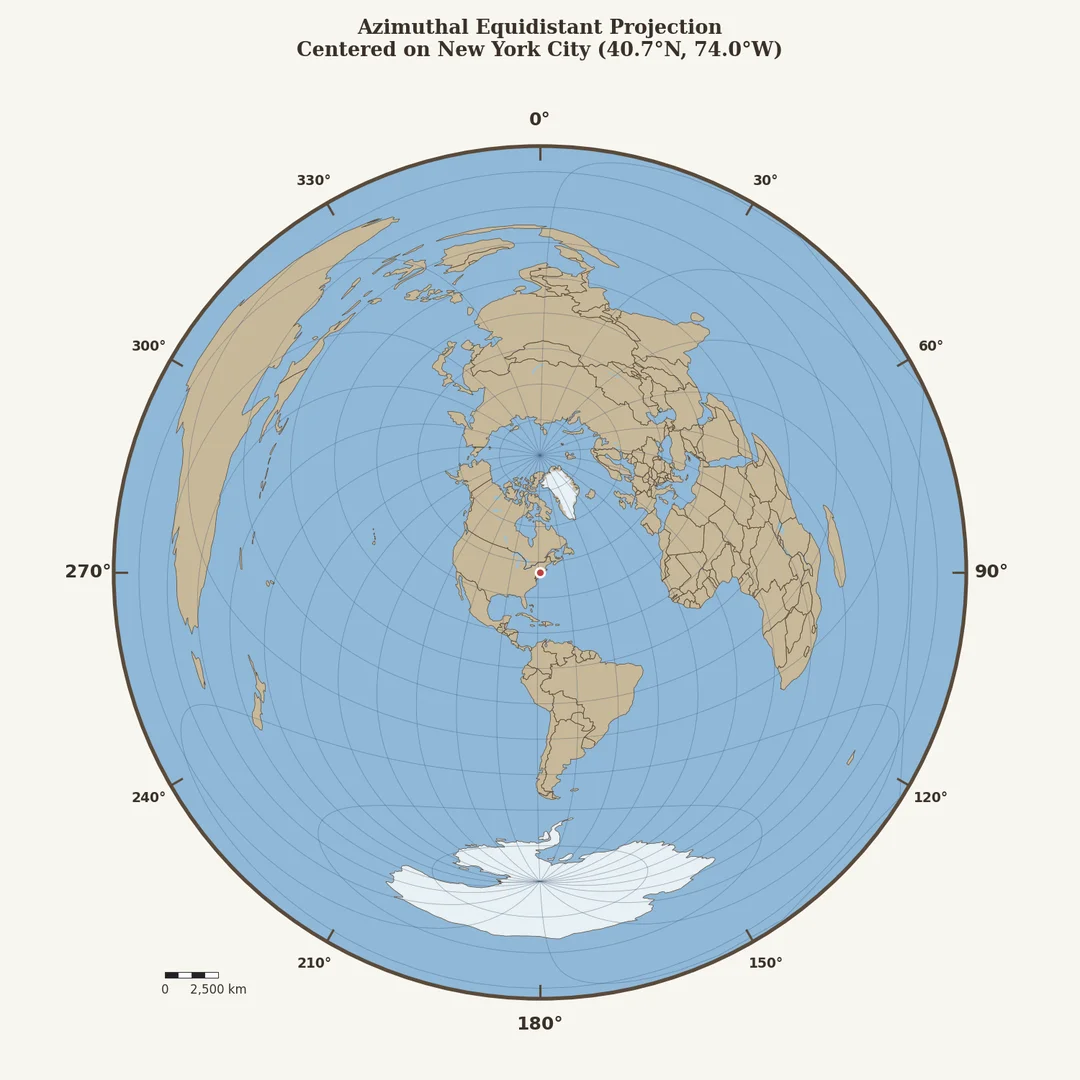
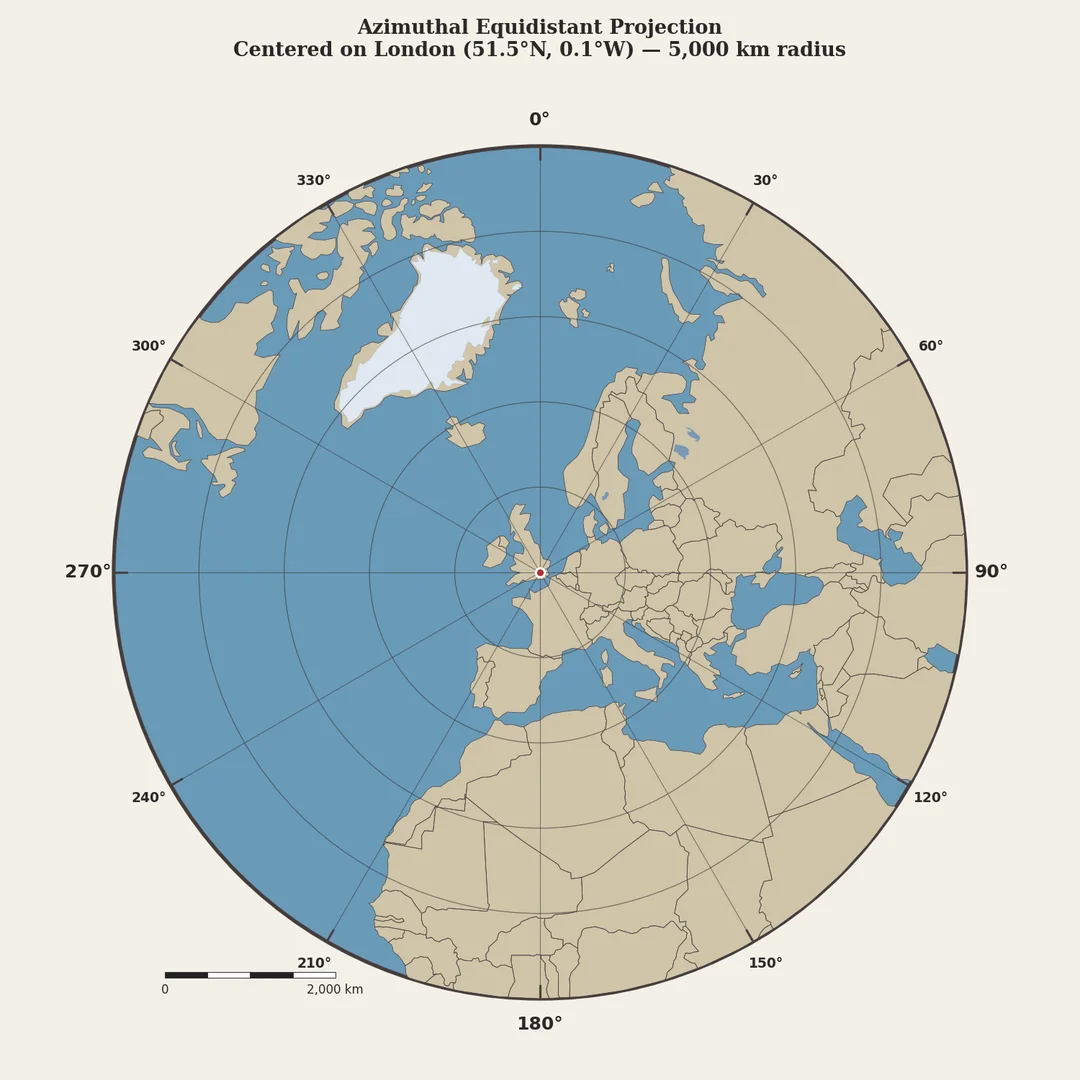
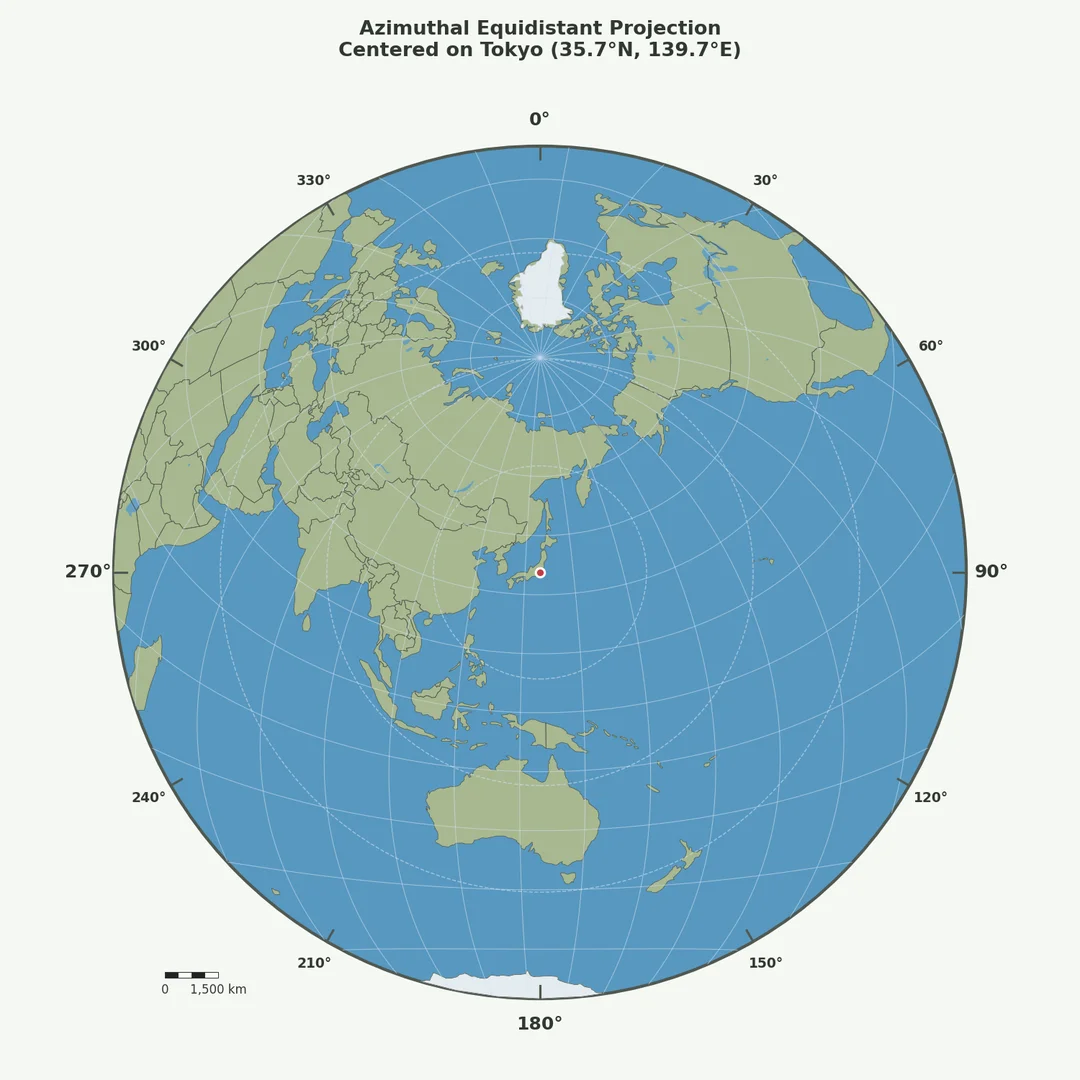
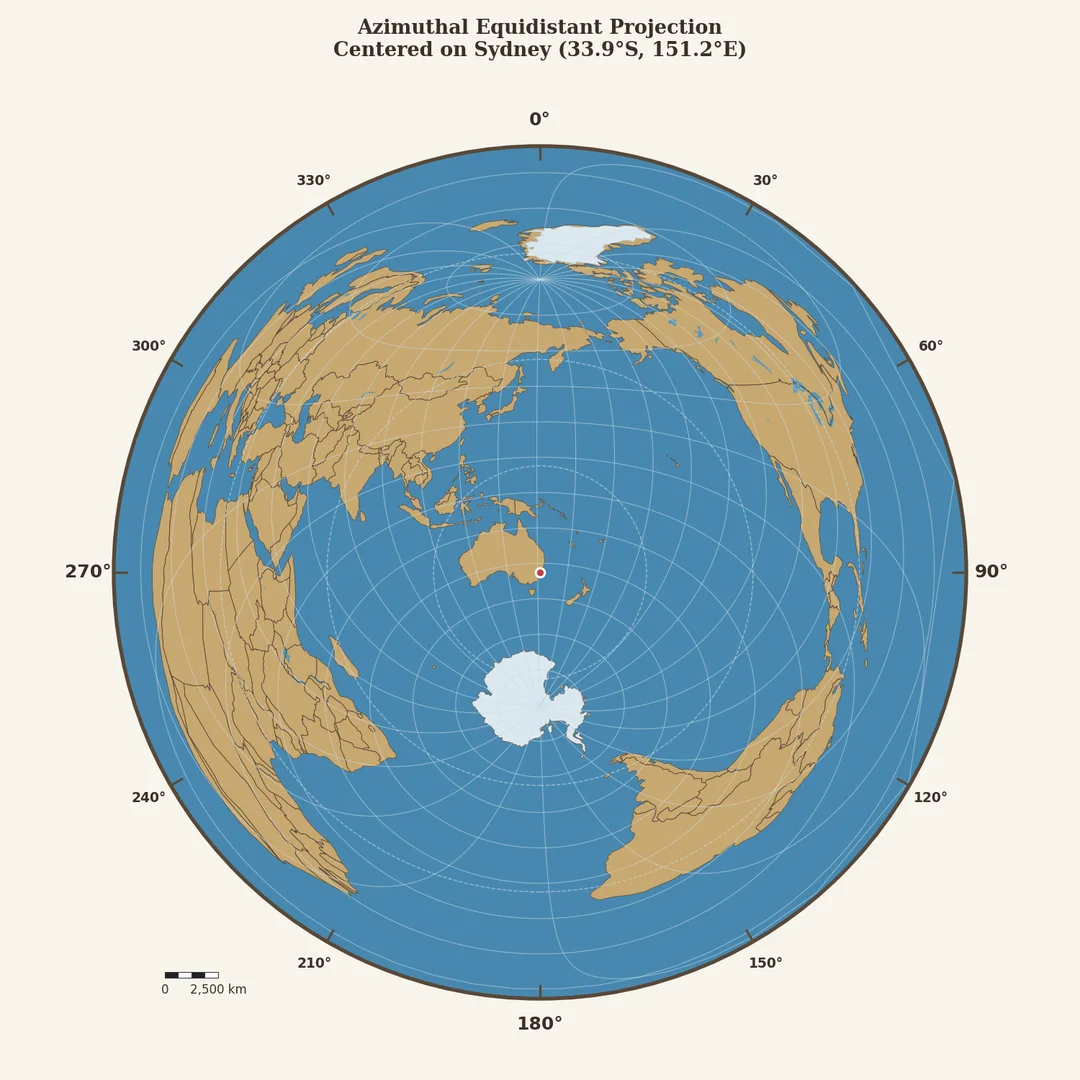
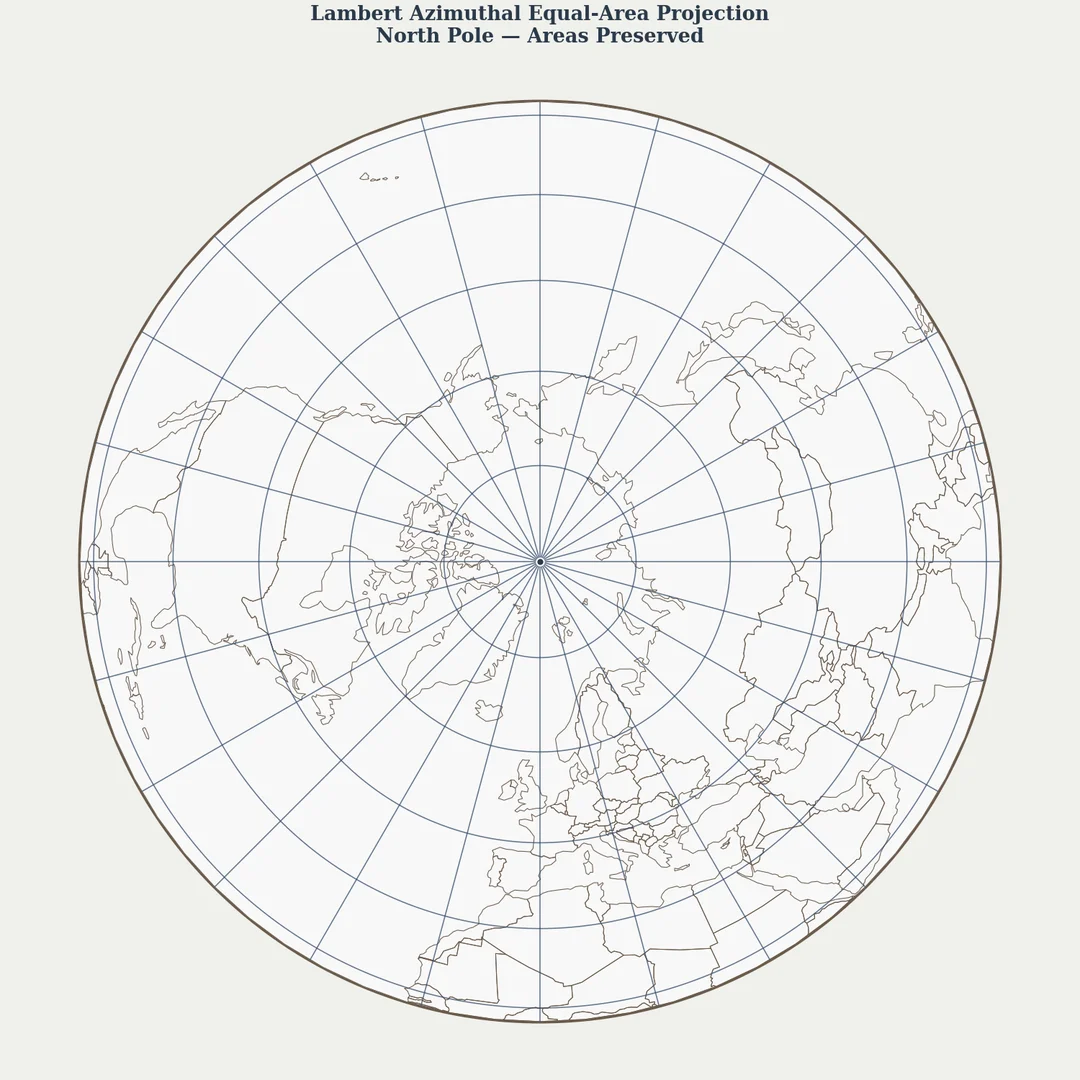
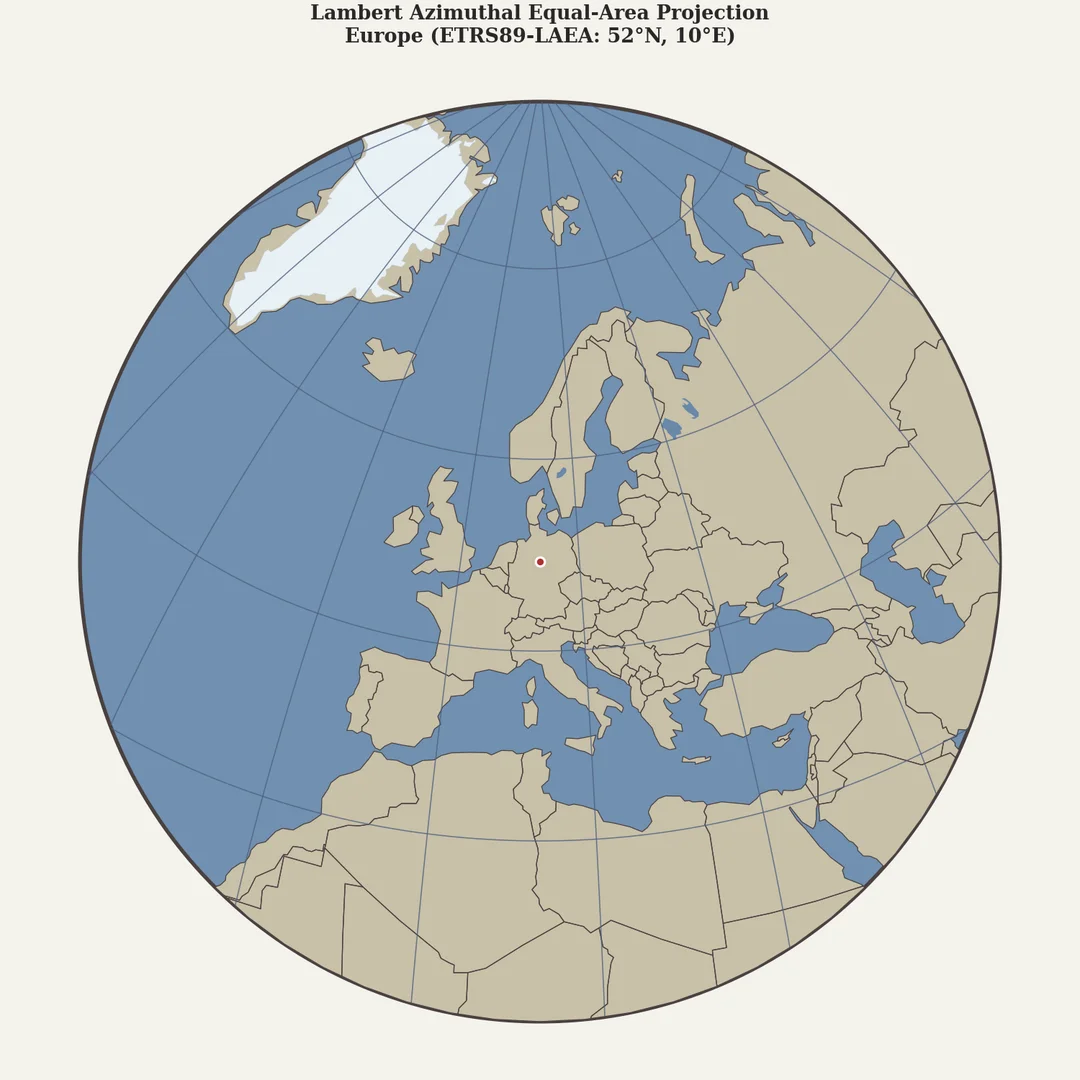
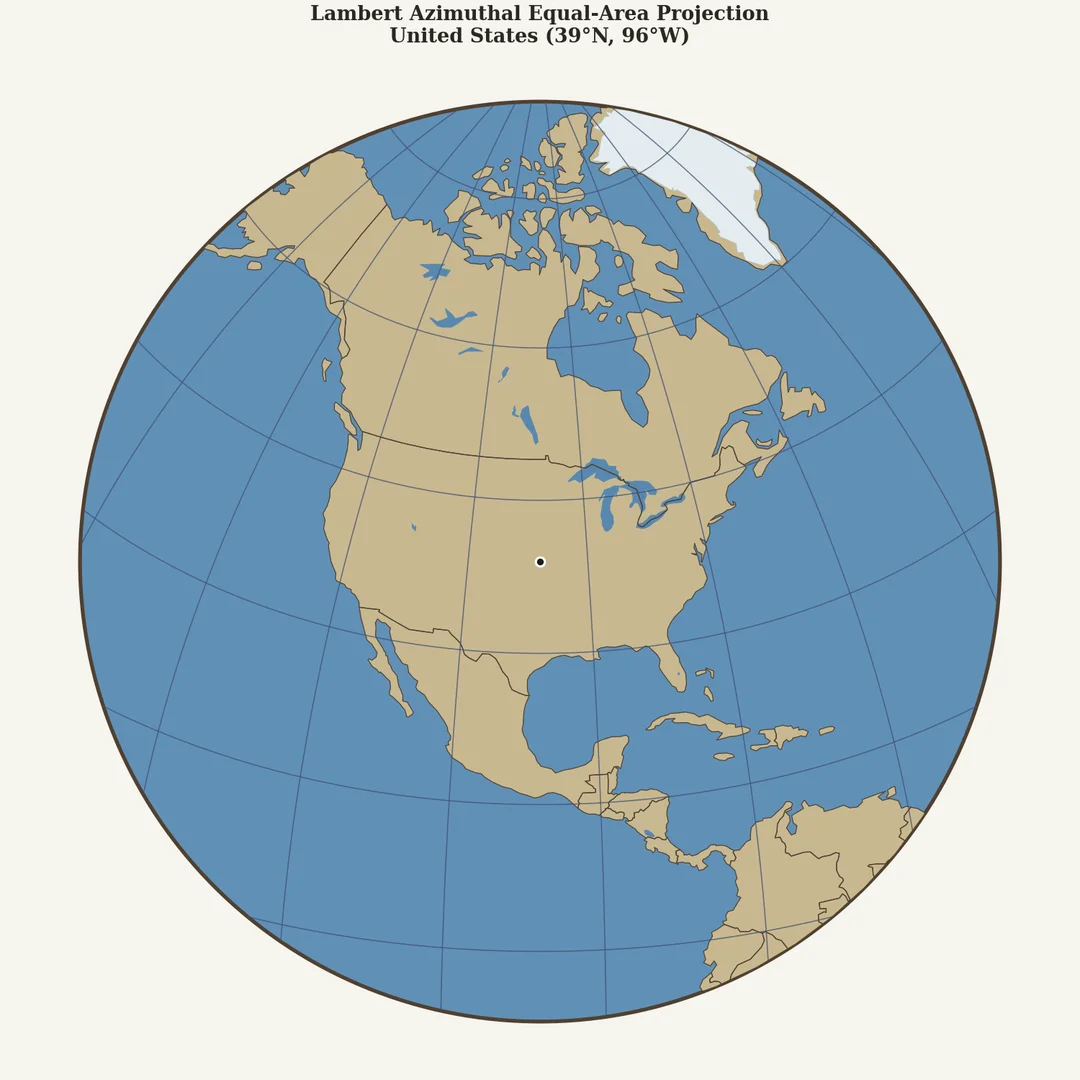
Azimuthal projections map the curved surface of the Earth onto a flat plane that touches the globe at a single point. From that center, all azimuthal projections preserve one critical property: true direction. The angle from the center to any other point shows the true compass bearing you would need to travel. What differs among azimuthal projections is what else they preserve.
| Property | Azimuthal Equidistant | Lambert Equal-Area |
|---|---|---|
| Distance from center | Accurate | Distorted |
| Direction from center | Accurate | Accurate |
| Area | Distorted | Accurate everywhere |
| Shape | Distorted at edges | Distorted at edges |
| Great circles as straight lines | Yes (through center) | No |
| Best for | Navigation, radio bearings, distance analysis | Thematic maps, statistical mapping, area comparison |
Azimuthal Equidistant Projection
The azimuthal equidistant projection preserves two critical properties from the center point:
- Distance: The straight-line distance on the map from the center to any other point equals the true great-circle distance on Earth.
- Direction: The angle (azimuth) from the center to any point shows the true compass bearing you would need to travel.
This makes it invaluable for applications where you need to know "how far?" and "which way?" from a specific location. The name comes from azimuth (a direction measured as an angle from north) and equidistant (equal distances preserved from the center).
Great Circle Navigation (Equidistant)
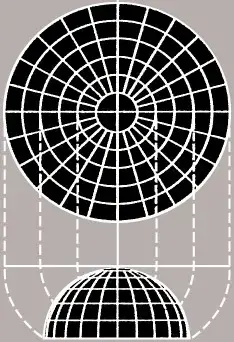
Image: USGS
A key property of the equidistant projection: any straight line drawn through the center point lies on a great circle, the shortest path between two points on a sphere. This is why the projection is so valuable for aviation and radio: draw a straight line from your location to your destination, and you've found the optimal route.
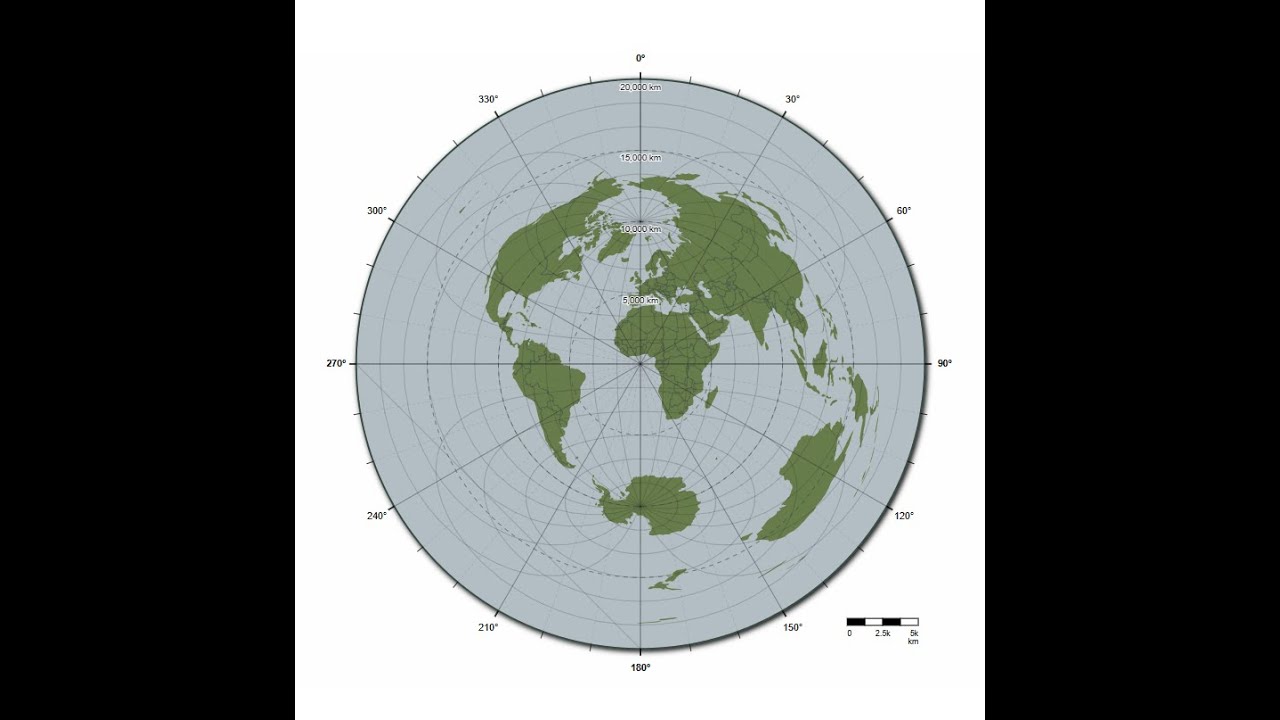
Video: A Quick Overview of the Azimuthal Equidistant Projection
Video Transcript
When mapping the world from a single point, how do you keep distances accurate? This is the azimuthal equidistant projection.
Centered on a chosen location, an azimuthal equidistant map shows every other point at the true great-circle distance and compass direction from that center. Imagine stretching the globe out radially from that point — distances from the center stay correct, directions do too.
Take a look at this animation. At the top is a 3-D globe and at the bottom an azimuthal equidistant map centered at the same point. Each colored spoke is a meridian; follow any spoke outward from the center and you'll see that the radial distance on the flat map equals the true great-circle distance from the center on the globe. When a point falls on the globe's far side it becomes hidden in the globe view — and it is also not shown on the flat projection. The set of points that remain visible on the projection therefore provides a clear frame of reference for what the globe is currently displaying.
You can use this projection when you need accurate bearings or ranges from one site. For example: radio planning, expedition maps, or local route planning. But remember: distances between two non-central points are not preserved, and shapes can distort near the rim, and the antipode can smear into a ring.
To learn more about azimuthal projections and generate your own custom maps, you can visit azimuthalmap.com.
View Interactive Animation — explore the globe-to-projection mapping in real time
Lambert Azimuthal Equal-Area Projection
The Lambert azimuthal equal-area projection, presented by Swiss mathematician Johann Heinrich Lambert in his 1772 treatise Beiträge zum Gebrauche der Mathematik und deren Anwendung, preserves a different property:
- Area: All regions on the map are shown at their correct relative size. A country that's twice the size of another will appear twice as large, regardless of where they are on the map.
- Direction: Like all azimuthal projections, directions from the center are true.
Lambert called this a "synthetic" azimuthal projection. It is not a perspective projection (you cannot create it by shining light through a globe), but rather is constructed mathematically to ensure equal area. The projection is widely used for thematic mapping, statistical analysis, and continental atlases where comparing the sizes of regions matters more than measuring distances. (USGS PP1395, Wikipedia)
Area Preservation (Equal-Area)
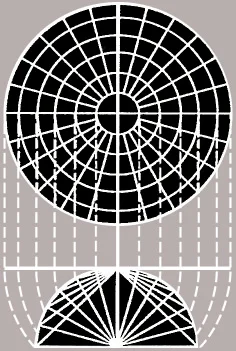
Image: USGS
Unlike the equidistant projection, great circles are NOT straight lines on the Lambert equal-area projection (except those passing through the center). The trade-off for preserving area is losing the straight-line great-circle property. However, the equal-area property makes this projection ideal for statistical maps, density visualizations, and any application where accurate area comparison is essential.
What These Projections Are Not
Neither projection is conformal: they do not preserve local shapes and angles (like the stereographic projection does). Neither is a perspective projection: you cannot create either by projecting light through a globe onto a plane. Both are constructed mathematically to achieve their specific properties.
The fundamental trade-off in cartography: no flat map can preserve both area and angles simultaneously. The equidistant projection preserves distance (at the expense of area), while the equal-area projection preserves area (at the expense of distance). Choose based on what property matters most for your application. (USGS PP1395)
The Three Aspects
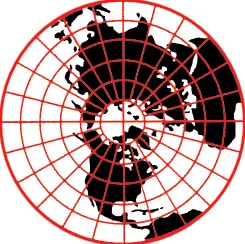
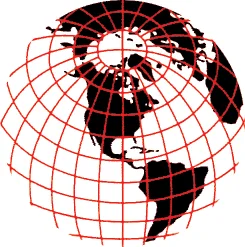
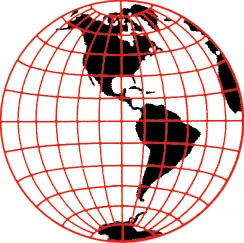
Both azimuthal projections can be centered anywhere on Earth. Cartographers categorize them into three aspects based on where the projection plane touches the globe. Lambert's 1772 paper discussed the polar and equatorial aspects; the oblique aspect is equally popular today for location-specific maps.
Related Azimuthal Projections
The azimuthal equidistant and Lambert equal-area are part of the azimuthal family. All are centered on a single point, but each preserves different properties:
Beyond single-center projections: The Two-Point Equidistant projection preserves distances from two chosen points. The Hammer projection (1892) is a modification of Lambert's equal-area that shows the entire world in an ellipse, created by halving vertical coordinates and doubling meridian values.