Globe to Azimuthal Equidistant Projection Animation
See how the azimuthal equidistant projection maps the three-dimensional Earth onto a flat surface, preserving true distances and directions from the center point.
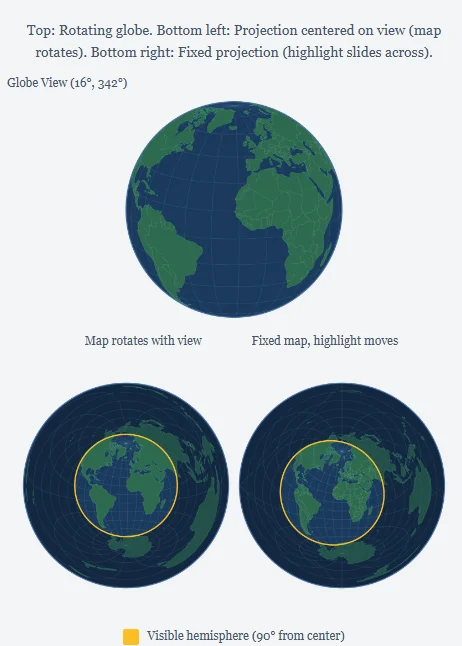
Top: Rotating globe. Bottom left: Projection centered on view (map rotates). Bottom right: Fixed projection (highlight slides across).
How This Animation Works
Top: A rotating orthographic globe showing Earth from space. The visible hemisphere—the half of Earth facing you—is highlighted.
Bottom Left: An azimuthal equidistant projection that rotates with the globe. The center of this map always matches the center of the globe view, and the yellow ring shows the boundary of the visible hemisphere. Everything inside this ring corresponds exactly to what you can see on the globe above.
Bottom Right: A fixed azimuthal equidistant projection centered on 30°N, 0°E (roughly North Africa). As the globe rotates, the yellow highlight slides across this fixed map, showing which portion of the projection corresponds to the currently visible hemisphere. Notice how the circle distorts into an ellipse when the view center moves away from the projection center.
This visualization demonstrates a key property of the azimuthal equidistant projection: distances measured along any straight line from the center point are accurate. The yellow ring represents a 90° angular distance from the center—exactly one quarter of Earth's circumference.